
 By
By 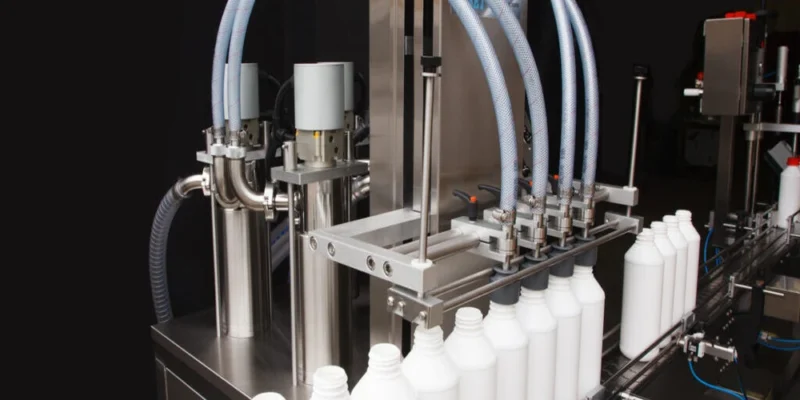
Metal containers behave differently from plastic ones in ways that matter on a production line. They dent rather than flex, they conduct static, their seams and seals are less forgiving of variation, and their contents are frequently the sort of solvent-based products that impose their own requirements on everything around them. Understanding can filling properly means understanding those differences before selecting equipment.
What Goes Into Cans and Why It Matters
Metal cans and jerry cans dominate for paints, coatings, solvents, thinners, lubricants, adhesives, agricultural chemicals and edible oils. Many of those are flammable, and most are chemically aggressive toward the wrong seal material. The container is chosen for barrier properties and durability rather than convenience, which means the filling equipment has to accommodate the container rather than the other way round. Establishing the product’s flash point and chemical characteristics is the first specification step, not the last.
Flammable Products Change the Whole Specification
Where a product’s flash point brings it into a hazardous area classification, everything within that zone must be suitable for the atmosphere: motors, sensors, control enclosures, lighting and the machine itself. Bonding and earthing to dissipate static become essential rather than advisory, since a liquid flowing through a nozzle into a metal can generates charge, and a spark in a solvent vapour is exactly the failure mode the whole regime exists to prevent. Ventilation and vapour extraction sit alongside this. None of it can be retrofitted cheaply.
Filling Method by Product Type
Free-flowing solvents and thinners suit flow-meter or gravity filling. Paints, coatings and adhesives are viscous and often thixotropic, needing positive displacement through piston or lobe pump systems. Products that foam require a diving nozzle filling beneath the surface. Where product is sold by weight, or where density varies with temperature and batch, weigh filling on load cells is more accurate than volumetric measurement and produces a per-container record.
Handling Metal Containers
Cans dent, and a dented can is scrap that also carries the product inside it. Conveyor guides, transfer points and stop gates all need designing to control containers without marking them. Empty cans arriving nested must be separated and placed upright, which a denester does automatically and which is otherwise a tedious manual task that limits line speed. Lid placement and seaming or clinching follow filling, and the seal quality there determines whether the product survives storage.
Neck Size, Splashing and Fill Speed
Cans frequently have narrower openings relative to their volume than plastic pails, which constrains how fast product can enter without splashing. Splashed product on the rim compromises the seal, contaminates the outside of the container and becomes a cleaning problem. The usual answer is a two-stage fill: fast to most of the target, then slow to finish. Nozzle design and drip control matter here too, since a nozzle that drips between fills marks every container it passes over.
Accuracy and Giveaway
Systematic overfilling to avoid underweight complaints is common and expensive. On a five-litre can of coating filled a percent over, across a year of production, the value given away is significant and appears nowhere in any report. Automatic systems hold a much tighter tolerance than manual filling, and the recovered product frequently funds a meaningful share of the equipment. Ask any supplier to state the accuracy achievable with your specific product rather than a general figure.
Cleaning and Product Changeover
Coatings and adhesives cure, and equipment left uncleaned becomes equipment requiring dismantling. Ask how the wetted path is drained and flushed, whether cleaning can be done in place, how long a colour or product change takes, and whether tool-free disassembly is available. For a paint operation running many colours in short batches, changeover time is usually the specification that determines real output, well ahead of nominal filling speed. Suppliers of can and jerry can filling equipment should discuss this early.
Labelling, Coding and Traceability
Regulated products carry information that has to be right and has to be legible. Hazard labelling, batch codes, fill dates and expiry information are frequently mandatory for coatings, chemicals and agricultural products, and an unreadable code can invalidate a shipment as effectively as a defective seal. Decide whether coding is applied to the label before application, printed directly onto the container, or marked on the lid, and check that the method survives the product itself, since a code printed on a can that is later wiped down with solvent may not remain readable. Where traceability is required, a system recording fill weight and batch against each container is worth specifying rather than adding later.
The Stations on Either Side
A filler in isolation moves the constraint elsewhere. Upstream, containers must be denested, positioned and conveyed. Downstream, lids are placed and secured, labels applied, and full containers palletised, which for filled metal cans is heavy repetitive work and a genuine manual handling risk. Deciding which of these to automate now and which later is a legitimate staged approach, provided it is deliberate rather than an oversight discovered at commissioning.
Specifying Sensibly
Start with the safety data sheet, the viscosity at working temperature, the foaming behaviour and the container drawing. Establish the area classification. Then discuss filling method, handling, changeover and support. Ask where spares are held and what breakdown response applies, since a stopped line costs production every hour. Approached in that order, can filling equipment gets specified around the product and the environment rather than around a throughput figure that turns out to be unachievable in practice.









Comments